Showing posts with label Youthkiawaaz. Show all posts

Thursday, May 3, 2018

The Manifesto of Batman: On generation gap and night life.

If you don’t have a difference of opinion with your parents, be it - social, political or cultural, then you are not going towards progress. 

Like charity, progress begins at home. You have to oppose and present alternatives to the views that they hold because you represent a new time and generation. Some call it generation gap while I simply see it as progress. You are an anti-thesis to your parents, and thus a synthesis needs to be there for a healthy family relationship - without a generation gap. 

For example, my father has always been an opposer of CPM, the party, while maintaining an apolitical life. As opposed, I am a left sympathizer while maintaining an active political life. 

Now coming back to the synthesis that I am proposing here: My father has always been very vocal about sleeping early and waking early, a practice which traditionally most people do. I was forced to sleep at 11 pm until middle school and once I got my own bedroom, my father had to give up his demand. I would sleep at 3/4 in the morning and still be up for school. But, I have never studied after waking up in the morning.

But the point remains that I have done a good job in my life. In fact, I prefer to work at night as opposed to the morning. I believe I can deliver better if I work at night. And, I believe here I represent a social class – ALL THE PEOPLE WHO LOVE TO WORK AT NIGHT and also deliver a better performance at night.

But the planet Earth works during the day and sleeps during the night, right? 

Let me explain what actually happens. Daytime is a hegemony of the society imposed on all of us. Just like patriarchy, its a social construct too. 

Let us ask ourselves, why do we work in the day? 
  1.  Because we have natural light for working.
  2.  Because everyone works in the day. 

Since everyone works, so our business also makes sense in the day. But, again why do everyone works in the day? Because, till half a century ago we didn’t have enough energy sources to light up our offices and work all night. So, the night was for resting and day for working. Dawn and dusk being leisure times. 

In the early stage of capitalism, women were being exploited in the name of equality. They were given jobs just like their men comrades but would be paid less. 

Similarly, we have a night workforce now, who are being exploited equally, if not more, but paid the same as day workers. Since the night workers get equal pay they are happy with it, but again, the leisure, for which we all work remains a monopoly of the day workers. 

The pubs open in the evening and close at midnight, a night worker’s working time. The malls and grocery shop open in the morning, a night worker’s sleeping time. 

Also, my dad’s prime concern… what about the health?

Well, my body clock loves the night and I don’t mind taking a shit or having a bath at midnight. The body can adjust just like it adjusts different time zones with a mild jet lag. The most important thing is food. Who will give me food throughout the night? 3 times to be precise.

Thus, as a representative of the nightcrawlers, I demand
  1. 24 hours work life with equal opportunity for leisure, safety, and eatables
  2. 24 hours market and transport.
  3. Higher pay if #1 and #2 are not ensured.
  4. A choice to choose to work at night even if the employer closes at night. The only problem with that is the requirement of energy, which needs to be negotiated with the value of work produced by night workers. 

Nightcrawlers of the world, unite! 
You have nothing to lose but your laziness!

Tuesday, September 4, 2012

Mr. India - A story of Drugs, Fame & the Virus

Manipur, mid-1980s.

The Manipuri youth were enticed by a new wave of the drug coming from the Golden triangle through the porous India-Myanmar border. It was cheaply and easily available in every street and corner of Manipur.

According to L. Deepak, the president of Manipur Network of Positive People (MNP+), in the beginning, he and his friends were lured by the purveyor known to them that it was the hippiest thing happening in America and was dolled out without charging any money.

And of course, later on, they were forced to buy. So the early 80's were also an era when crime increased in manyfold in the Manipuri society as the loony drug addicts hunting for their daily dose started stealing, robbing and snatching gold earring from small kids occasionally killing them in the process (It is a custom for meitei boys and girls to wear gold earrings until they reach adulthood). Due to these incidents during that murky era, it was even rumoured that drug addicts are vampires who suck blood.

Like any ordinary youth of that era, Pradip Kumar also fell prey to the setup. A 13-year-old guy took refuge to drugs. He started with heroin, "I started doing drugs just for fun. I was probably 14 when I tried heroin for the first time and then marijuana," he says. But the narcotic high doesn't always last forever. By the time he decided enough was enough, that was in 1992, what then looked like a promising career in wrestling and powerlifting was already in tatters.

But the worst was yet to come. The syringes had taken their toll. In 2000, he was diagnosed with HIV. "I thought my end was near. I kept telling myself: I will die today, tomorrow or, probably, the day after. It frustrated me no end and I was dying a slow death," he told TOI.

He remained aloof from the world, from the indivisible society confining himself only to his house. ART (anti retroviral therapy) at that time was not freely available as of now and every month his family has to cash down about INR 35,000 a month by procuring from the local pharmacies. In spite of that, his health was failing from bad to worse and literally, he started crawling.  After staying indoors for two years, Pradipkumar finally decided to battle the dreaded disease. He joined a gymnasium in July 2003.

According to him living with HIV means ‘my immune system is weak’ and he says he has never been affected by any form of malady since he started bodybuilding. The only sickness he had experienced was the ‘mental depression’ caused by the untoward remarks of people about his HIV status.

In December 2007 he won the Mr Manipur title in the 60 kg category. The celebrated days was also the time when he made a crucial stirring decision to stand up for those living with HIV/AIDS. Consequently, he bluntly and boldly announced to the world that ‘he is HIV Positive’. He thought by revealing his status to the world, the discrimination and stigma towards the HIV+ people would eventually decrease.

Henceforth followed a frenzy of media and public attention. He went for the nationals and won the silver in the 50th senior national bodybuilding championships in Margao.

From being infected with the killer virus in the summer of 2000 and hiding it from the world till 2007 when he became Mr. Manipur to winning a silver medal at the National championships, his is the stuff that we thought only the legendary Magic Johnson was capable of.

"It's been such a tiring journey," confesses Pradipkumar, who is now the brand ambassador for Manipur AIDS Control Society.

Today Pradip may be a famous HIV Positive but also a disgusted man with the attitude of some of the agencies and especially the Manipur state government. The Manipur State Aids Control Society made him their brand ambassador for two years from March 2008 to march 2010 paying him INR 6000/month. But he was not happy with the way they were functioning or using his HIV status.

Sometimes Pradipkumar feels like an HIV+ animal exhibited in the zoo for the world to see. He only wants ‘the society to be his walking stick’ and expects all HIV+ people to be treated fairly. He affirms again, ‘nobody wanted to be an HIV+’ and that it is not HIV/AIDS that kills the person but the discrimination of the society.

His message for those who are living with the virus is ‘bodybuilding is the best medicine”


[Excerpts from Pradip Kumar's interview by Oinam Doren, a freelance journalist]

This article was first published on Youthkiawaaz.com. Click here to find it. 

Monday, June 25, 2012

Rocumentary of the Daddy : Amit Saigal

What do you do when you are too passionate about some thing but don't get enough exposure to your need?

Revolution has many faces. From the violent struggles of Che Guevara to Gandhi's Satyagraha, all are different forms of revolution. Even a new start to something which is non-existent in a culture is a revolution itself.

But, Amit Saigal never knew he would be later known as a revolutionary leader in the field of music production when he was playing with his college band Impact in the 80s. All he felt was a need for a platform  for the Indian bands to showcase their art. The only platform being the college fests those days, it was hard for any passionate musician to make a living out of it as they had a very limited reach and exposure.

Amit Saigal and Sam Eric Lal published a magazine at Allahbad in early 1993. When Saigal printed the 2500 copies of the 1st issue, the idea was 'to come up with RSJ which would provide news about rock music anywhere in the country' recalls SamThus the Rock Street Journal was born.


At first it was a subscription-only magazine which was promoted by Amit in the different college festivals. With time the collective sub-continental non-bollywood music news monthly gained popularity and subscribers increased making the magazine most sought after music magazine in the country. This made them to shift the magazine's base to the country's capital and popular rock destination, Delhi.

But, like most revolutionaries do, Amit didn't stop there with the cup of success-blended coffee in his hand. He knew he had a long way to go. Up next was RSJ's major extravaganza, the Great Indian Rock. A rock festival where one could live rock, breathe rock and feel rock. 


The 1st five versions of the event were presented entirely by the RSJ. Since the 2000s, Indian music fellowship almost changed drastically. With the popularity of internet and digital music, the mission RSJ once started saw a brighter day. They used these tools as a fuel and came up with a new venture, the Great Indian Rock Albums. Bands from all over the country would contribute their demos to RSJ who would choose the best ones to perform in the fest and also would feature them to the GIR archive albums. 

Amit Saigal can be compared to what Ozzy Osborne did with his OzzFest to revolutionize Heavy Metal music. Amit Saigal is the father of independent music in India. He brought the underground music scene to the stage it is in today. The Papa of Rock will always be in the Hall of Fame in the Indian Music Industry.

(This article was first published on youthkiawaaz.com. Click here to find it.)

Saturday, May 19, 2012

Students and Social Work: 5 Ways Towards a Better India

Our nation is the home of multimillionaire Mukesh Ambani, but it is also the home of millions of people who survive on Rs 32 per day. I always wonder why this country with so many energetic youths is considered a backward nation, even though we are good economically, culturally, politically and have one of the best defense systems. The reason lies within. We have the energy, we have the will, but we do not know how to channelize it for developing a better nation. So here I present you 5 things which every Indian student/youth can do to see a better India.


1. Make use of the reservation system: We know India has a strange and unique caste based reservation system which was implemented 60 years ago to avoid the social differences. But, after 60 years we are still in the same position. Those who could make use of the reservation system have already done it and are doing well in the society, but still many Scheduled caste/Scheduled tribe/Other backward caste students don’t even get to go to school in many parts of the country.

Many people opt for a revised system of reservation on the basis of per capita income; well it is not possible considering the political conditions of India. But, it is inevitable that a well-to-do dalit student will really feel the conditions faced by another dalit person. So, why not make use of that boon which government has already provided us??

What I propose is a ‘Stipend Foundation’ for the reserved class. Those who are listed in the SC/ST/OBC lists can work for their brothers and sisters. We are provided with stipends from the government, so why not donate the same for those less privileged students?? We are good enough to make our own living, so why wasting the governments’ funds on parties?

2. Donate clothes: We all like to shop every now and then, do we even keep track on where our used clothes go?? Sometimes in a dustbin, or sometimes used as a napkin to clean out after party stuffs. So, why not donate one cloth to a poor child every time we buy a new one?? It’s as good as the aforestation campaign. And, we can easily afford it too.

3. Donate books: After every semester, we just wait for the new book, what happens to the ones we had been using in the previous semester?? Most of them are not needed in the future isn’t it?? So we can easily donate them to someone who needs them but cannot afford to buy one or even issue one from a library.

4. Start free tuition: Knowledge increases when it is shared. Instead of spending our extra minutes on the Facebook page, we can teach at least one poor child. Teaching a middle school guy is not a big job for us, but it is a huge task for his construction worker parents. Think over it!

5. Concert for a new audience: If you are a musician and you are fed up of the boos and less encouraging comments from your friends, find a new audience. Go to a slum and pick some random kids and play for them. You will get at least one interested child whom you can mentor. Who knows you might get a full band out of them.


This article is featured in Youth ki Awaaz : The Mouth Piece for the Youth
Link :
http://www.youthkiawaaz.com/2012/05/students-and-social-work-5-ways-towards-a-better-india/

Sunday, May 6, 2012

India After Gandhi : Why the country Sustains

A few days back I read a book named India After Gandhi: The History of the Largest Democracy by Ramchandra Guha. The book pointed out something which I could not overlook. In Indian education system, the sub-continental history ends with the British Empire or for some Gandhian biographers till Mahatma Gandhi’s death in January 1948. The rest is documented either in the political science books or in popular culture viz films, novels, etc.


This led me to think how such a huge country sustains and what India’s present position in the world scene is. India is a unique subcontinent in the whole world; its geographical location is also unique. Positioned just above the Indian Ocean, it is being surrounded by China, Pakistan, Russia, and the South Eastern countries. Being so diverse in culture, language, food habits, is very much vulnerable to be disintegrated. A huge population of a billion people in a developing country makes it more vulnerable. But still, it sustains and is making itself compatible to answer back the world powers.

This is because; India is a huge producer of talented human resource on cheap rates. This makes its economic position a dynamic one. If your economy depends on your population, then it’s a strength rather than having an export like gold or oil. Their demand doesn’t vary on the quality, but well trained human resource can’t be judged on quality. Indian economy sustains because of its population only.

The country is compiled with more than 21 major language groups; culturally the north India is totally different from the south, the north-east totally different from the west. Often incidents like the Richard Loitam death and Gujarat riots make the country bleed, but still, the whole nation again cheers for the Indian cricket team.

Actually, India is such a country where a person has multiple identities. A person living in Delhi can be a Hindu, Bengali, Scheduled Caste, Graduate, Middle class, a Delhite, and above all an Indian. While a person living in New York is an American. He speaks English, follows Christianity, and all eat similar dishes. This thing is common for all developed nations. India is so diverse also has maintained her dignity and is developing itself from nuclear sector to sports sector.

The country’s main backbone is the national feeling induced by the British during their rule. The Indians, however conflict they had, fought for freedom as one unit under the Mahatma. And, even today even if the Hindus and Muslims are fighting over the Ajodhya issue, they stand like brothers in an international forum. The day this brotherhood dies, will be the last day for a united India.

This Article is featured in Youth Ki Awaaz: Mouthpiece for the Youth


Saturday, April 28, 2012

Five Reasons Why Kalam is the Most Suitable Person to Become President Again

Recently Union Agriculture Minister Sharad Pawar said to the media that he prefers ex-President Dr. A. P. J. Abdul Kalam as the President of India again. Well, Dr. Kalam, a true visionary in his own right is actually the best person to become the first citizen of the Indian union.


He has been in that post earlier and we all are a witness that he is and shall remain as a charismatic figure in the Hall of fame of Indian politics. Here are the five main reasons why we need him as our President:

Non-Political Image: Mr. Sharad Pawar also backed him for his apolitical outlook towards his nation. Dr. Kalam has contributed the most to the Indian nuclear science and is a pioneer of education and progress. He seldom talks about unreal development plans. His speeches are a testimony of his vision of a better India.

Advocacy of Secularism: Dr. Kalam is a man of reality. He is equally well versed in Bhagawat Gita, Koran, The Bible, etc. Whenever he speaks, he speaks to every culture, every religious community of India. He is the perfect example of a Gandhian soldier.

Youth Icon: He is a scientist, educationist, philosopher, and true leader. His visions and speeches encourages the youth. He understands the problems faced by the 21st century speed-loving generations. He visits colleges and schools regularly to interact with the youth and understand the future of our nation.

The People’s President: The Indian Presidential system respects the President as the first citizen of India. Dr. Kalam in his last tenure proved his position. He did his job a true leader. Within one year of his election, he visited almost every state of the country and met with the people. He is not among those who once elected take a 5-year-long vacation in the VIP quarters.

A Nation Builder: We all know about his three visions, to protect and nurture the freedom we earned, to gain self-confidence as a great nation, and to stand up to the world and answer the Americans, the French, the Russian, the Chinese and the whole world that we are 60-years-old now, old enough to make a shift of generations.

His visions directly appeal the next generations to come up for the country. If he is re-elected as the President of Indian Union again, then Bharat Ratna Dr. A. P. J. Abdul Kalam can really change the image of our country before the world.


This article is featured in Youth ki Awaaz : The Mouth Piece for the Youth


Thursday, April 26, 2012

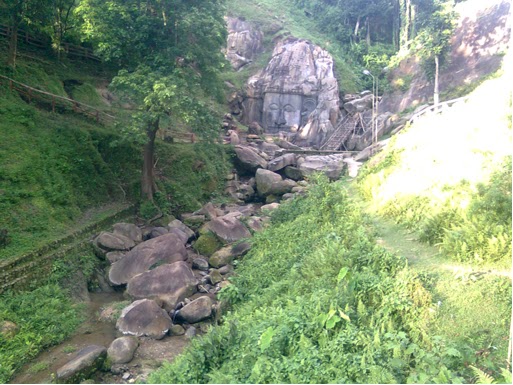
A Travelogue of Unokoti: An Unexplored Paradise in the North-East

It was the summer of 2009. I was spending the vacation at my ancestral home at Dologaon, Kailashahar. After a heavy lunch one afternoon, I was too bored to watch TV or read any slow novel. So, I set out on an exploration. I asked my nephew to come with me and we two rolled on a new Hero Honda Glamour. It was a trip without a plan…


The Destination: There is an ancient tourist destination just a few kilometers north from Kailashahar, Tripura in the lush green hills of Unokoti District. Even though I had never visited it before, I had heard stories about the place. It boasted of one less than ten million rock carvings of Hindu gods and goddesses.


The Myth: Since I was a kid, I had been listening to the myth about the place. My grandmother used to say that there was a king named Jujaru-FA who ruled the place many, many years ago. One day he was blessed by a visit by Lord Shiva who granted him a boon on one condition- he had to make sculptures of 1 crore different Hindu gods and goddesses before the next sunrise. Jujaru got to work and had finished 9,999,999 sculptures when the first sunray touched the ground. Thus, he could not complete his objective and named the place Unokoti, meaning one less than a crore.

The Location: Unokoti gives you a divine and spiritual feeling with a natural fragrance. Just as you enter the site, you see long unbroken chains of stairs going up and down the hills. They connect the whole area and without them, it is quite possible to get lost amongst the millions of rock images in the jungle.

The central part is like a necklace of the jungle. There is a year-round waterfall and at its base, there is a small pond with fishes, where you can take a bath too. Just beside the falls is the mighty ‘Unakotiswara Kal Bhairava,’ a 30 feet high rock image of Lord Shiva.

The Art style differs from the classical and depicts typical tribal features both in decoration and structure which makes them unique. The three rock-cut Ganesha figures on a rock fall; downstream of a local spring which flows right on their heads gives us the illusion of a bath scene.

The Main Attraction:
Its importance as a sacred place has decreased considerably in the recent years. However, every year in the month of April, a seven-day festival called the Ashokashtami is celebrated there. Devotees from the older generation still believe that one bath in that natural tank every year will wash away their sins and will lead them to heaven. Unokoti is the most sacred place in Tripura during Ashokashtami, Makar Sankranti, and Maha Shivaratri.

They say North-east is a paradise unexplored. Well, of course, it is and I am a witness to this. There are places where you go and find nothing more than a board from the Archeological Survey of India. But, in reality, the place deserves much more than that.

Such is the case with the Unokoti. A district was named after it recently, but very few Tripuris and even lesser Indians really know about its historic and artistic importance.

Below are the pictures I took with my Nokia 2700 classic. :)


This Article is featured in Youth Ki Awaaz : Mouthpiece for the Youth

The Side-effects of Democratic Politics

Who is a politician?

A politician is the one who deals with policies. He may be a policy maker or a policy editor. His job is to safeguard the constitution along with the fundamental rights of a democratic country through his policies.

The 20th century saw a revolution in the political arena of the third world countries. Most of the countries took refuge of the democratic form of government to run their countries.

There is a popular saying that, “politics is a third class ‘game’ played by fourth class people”. Well, politics is not a game. But democratic elections have turned out to be a game in a country with multi-party coalition format.

In India, the general view about the election is a competition among the ‘political’ class of the society to take the ‘throne’. To make the scene clearer, the TV channels have introduced the reality shows these days. Elections are no different from the reality shows. The participants who are the political leaders make a political agenda and present themselves before the voters. They do their best in the election campaign. Because, in everyone’s sub-conscious mind, they have a feeling that the election is the biggest challenge for a politician in a democratic country.

Now, let’s forget this self-styled game of winning and losing.

Who is a citizen?

In a democracy, a citizen is the one who has elected the government to run his country. And because there is a multi-party system, he has the right to choose anyone, but is expected to follow; support the winner, i.e., the one who has made a successful government.

But, he may not support the government if he doesn’t feel like. It’s this basic of democracy which makes it a better form of governing as compared to monarchy or dictatorship.

The ‘winner’ of the election again is a people’s leader, if the majority chose him and he has to safeguard everyone. He is chosen to look after the whole country and not only those who voted for him.

Now, let’s take two cases and study them in view of the democratic system.

The Times of India, 18th April 2012: “Woman ‘molested’ for refusing to join Trinamool Congress”

Citation:We have received a complaint by Toton Das, who has alleged that his mother was molested by a group of people who also assaulted his other family members for refusal to join the Trinamool Congress. The woman later attempted suicide by consuming poison,” said the duty officer of Marishda police station in East Midnapore district.

Tehelka Magazine, Vol 9, Issue 17, Dated 28 April 2012: “We were warned of dire consequences if we mingled with Congress members”

Citation: “This group had tried to harass us before as well. Perhaps they were angry because of a few months ago, we went to attend a Congress rally in Agartala. We were warned of dire consequences if we mingled with the opposition party.” Pinky claims to have told this to the police, but it finds no mention in the FIR.

These are two stories of different states with a similar political history. The first one is of Mamata Banerjee’s Paschim Banga where the communists have been overthrown after a long rule of 35 years and the second one is the of Tripura, the last bastion of the Reds in India.

In both the stories, there is one thing common; a woman has been made the scapegoat. And, in both the stories the governing political parties have been accused.

My point is, if you are a good political leader then every citizen will support you without even a request because deep down inside, even the most corrupt man wants a good person to show him the way to a better country.

But, due to the political game of election, the ‘players’ develop a feeling of insecurity that they might ‘lose’.

Well, politicians need to learn the morals of politics once again. It’s your country that is losing her dignity with every passing election game, your loss or win is secondary.

This Article is featured in Youth Ki Awaaz: The Mouthpiece for Youth

Monday, April 9, 2012

Project Save Our Sparrow (SOS)

Its 21st century, a fast digital era. Today our morning breaks with SMS beeps and tweets. We are more familiar with the Twitter world than the natural tweets. But, can you imagine the world where there are no birds singing songs, no natural music?  Do you remember when did you hear a sparrow chitter last time? Provably no, no one does. It’s a small and useless bird, that’s what we think, don’t we?


In the last few decades, the population of sparrows has witnessed a sharp decline. The birds which could be found everywhere are hard to spot now. This is the result of various nature tempering activities of the humankind like deforestation; establishment of mobile towers; use of unhealthy pesticides and tempering the food chain and finally various forms of pollution.

Well, one man thought in a different perspective. Mohammed E. Dilawar, a nature conservationist with a difference could think beyond tigers & rhinos. He could see an urban wildlife extinction and he decided to bring back the house sparrow into the urban landscape again.

But six years ago, when Dilawar expressed his concern about this, nobody took him seriously. “When I spoke to people about it, they laughed at me.” He then started the Nature Forever Society (NFS) and pledged to restore the urban flora and fauna which generally gets unnoticed as forests remain the center of attraction.

This year, after getting thousands of feedbacks from various parts of the country, the NFS in association with the Burhani Foundation (India) has decided to go live. They started the project Save Our Sparrow (SOS), an initiative in which they distributed 52,000 bird feeders across the world on a non-profit basis.

This effort to save the Nature & Environment has been sent to Guinness Book of World Records as well as Limca Book of Records. The Limca citation says, "As the world celebrated World Sparrow Day, Indian Postal Department released a stamp of the house sparrow along with the rock-pigeon on March 20, 2010. Nashik-based Mohammed Dilawar, who initiated the movement in India, was at the forefront of the activities in Delhi."

But, these birds, being an indicator of environmental health, need to be saved before they can be seen only in books or on the internet. In nearly 260 cities and townships across the country - in states such as Maharashtra, Rajasthan, Gujarat, Karnataka, Madhya Pradesh, Tamil Nadu and West Bengal, free bird feeders and installation manuals were distributed to individuals, schools and various institutes.

Alarmed by their decline, a lot of NGOs and individuals have volunteered to the cause of the common house sparrows, currently facing a major threat from human developmental activities. If you are one who liked the chittering sound of the sparrows in your childhood, then it’s your time to pay for the opera you enjoyed.

Visit www.worldsparrowday.org and join in the campaign.

Let’s hope to see a better world tomorrow, because, hope is a good thing!


This article is featured in Youth Ki Awaaz: The Mouthpiece of the Youth, a national web-magazine.

Saturday, April 7, 2012

#Report: Mission ‘Clean’, Itanagar Green !


Ruma Nguri is just another engineering student of North Eastern Regional Institute of Science & Technology. But today she is organizing a ‘Clean Capital Complex’ in Itanagar. She realized a daily crisis which we ignore generally because it’s ‘government’s’ job to keep us satisfied.

Observes Ruma, “I was walking along with my friends; I stopped by to buy some ice-cream. We were chatting and eating. The ice-cream container, the stick etc… I did not feel like throwing it on the street but then I was left with no option as I can’t put it into my bag or carry it all along, so I had to dispose it on the road because there was no dustbin in my vicinity. I threw it down with guilt feeling and decided that something should be done about it...”

On 28th January, she had no plan, no support; but she desperately wanted to do something for the community she is depended on.

Ruma approached the NERIST Arunachal Pradesh Students’ Association and asked for support. She said, “Government has lot many big issues to take care of, at least some things can be done by us (students).”

The NAPSA family responded positively & almost immediately and they made a plan along with Ruma. They decided to recycle used steel cans as dustbins in and around the capital complex of Itanagar, Naharlagun & Nirjuli. They collected all the mustard oil cans available in the hostel mess or nearby grocery shops and painted them green. Ruma says it’s an ‘awesome’ way of recycling and believes that it will send a noble message to the government as cleanliness has always been an issue in the capital complex of Arunachal Pradesh.


[Picture : Proposed Dustbin Model ]

Today, on 7th April, 2012, they have scheduled to execute the plan. They will come to the streets. They will tie a green dustbin on every electric post in and around Itanagar. Students & faculty members of NERIST led by the NAPSA are going to take part in the event which is scheduled to start off at 7 am at NERIST Gate. This might not be the biggest change, but it is a small change that I am sure is going to pave way for the bigger ones.


This article is featured in Youth Ki Awaaz : The Mouthpiece of the Youth, a national web-magazine.

Link : http://www.youthkiawaaz.com/2012/04/mission-clean-capital-complex-student-dynamism-in-itanagar/
/

Friday, March 23, 2012

The Blade, The Vagina, The Painful Secret : Female Genital Mutilation in India

“I am 60 years old (Indian woman) now, but will remember that fateful day for the rest of my life. I must have been around 7 years old when my mother told me we were going to my grandma's house to spend the day with her. When we reached my grandma's house, my cousin (my mom's sister's daughter), who was a year younger than me, was also there. We were happy to meet each other.

Then, we were both led to a small room, which had a bed and asked to lie down. We kept asking "Why?" Suddenly, a lady dressed in black came into the room. By now, my cousin and I were terrified, not aware of what was to follow. 

Our dresses were pulled up and our panties pulled off, and we were asked to keep our legs apart. There were our mothers and our aunts holding our legs apart and then I felt something cold being applied to my clitoris, and then to my horror, the lady in black, actually held a scissor-like instrument and cut me there – I screamed and screamed but no one seemed to care. Then this same thing was done to my cousin, who was right next to me on the same bed.”


I came across this blog www.breakthesilencespeakthetruth.wordpress.com & found the above story on their home page. At first, I thought it was just another blog protesting against rapes & female feticides. But to my horror, this was something much more terrible. I searched the Google and did find pages related to the topic and then I was forced to write this post on one of the worst practice in human history.

Female genital mutilation/circumcision is a traditional custom practiced by many religious sects of the world. The World Health Organization defines it as “all procedures that involve partial or total removal of the external female genital organs for non-medicinal reasons.

It is probably one of the best kept open secrets of modern India. In India, it is widely practiced by the Dawoodi Bohra community, a sect of the Shia-Muslims, who are led by the Syedna. Locally termed as ‘Khatna’, this practice has no medical justification at all. Some of the reasons include family honor, increasing sexual pleasure for the male, enhancing fertility, social acceptance (especially for marriage) & preservation of virginity/chastity.

Until the 1950s FGM was used in England and the US as a "treatment" for lesbianism, masturbation, hysteria, epilepsy and other "female deviances". Later, The UK Prohibition of Female Circumcision Act 1985 makes it an offense to carry out FGM or to aid, abet or procure the service of another person. The Female Genital Mutilation Act 2003, makes it against the law for FGM to be performed anywhere in the world on UK permanent residents of any age and carries a maximum sentence of 14 years imprisonment. But, to date, no prosecutions have been made under UK legislation.

In India, the Bohra community is a very small one compared to the billion strength country, added to that, the girls are generally being circumcised just after/before they attain their puberty. So, the matter even though unjust, gets buried inside the girls’ mind like any normal process like menstruation. Many women believe that FGM is necessary to ensure acceptance by their community; they are unaware that FGM is not practiced in most of the world. A letter to Molly Melching, Chairperson of an NGO named Tostan working against FGM by an anonymous Indian lady exposes how this custom has been practiced for centuries; people are either too afraid or too embarrassed to raise their voice against such oppression.

A young girl undergoing the procedure by force experiences not just immense physical pain and risk of contracting infections due to the unhygienic manner in which FGM may be carried out but also extreme humiliation, and the realization that she must be subject to such torture because of her gender. Further, the basic aim behind FGM is to curb sexual desire in order to ensure that the women are not “unfaithful.” Such suppression is a blatant attack on the right to a dignified life and personal freedom.

Depending on the degree of mutilation, FGM can cause, severe pain & shock, uterus, vaginal and pelvic infections, complications in pregnancy and childbirth, sexual dysfunction, difficulties in menstruation & psychological damages among many consequences. In addition to these health consequences, there are considerable psycho-sexual, psychological and social consequences of FGM.

A typical profile of a woman who undertakes the job of female circumcision in India (covered by www.indianmuslimobserver.com) is a 75 year old uneducated but literate Bohra woman. She says that she has inherited this work from her family. Her grandmother used to perform ‘Khatna’ but her mother never learned the trade as she was married in an economically well-to-do family. She had done it for 35 years until her eyes stopped supporting her.

She has a rusted box containing five items: a barber’s razor (which she claims has been sterilized), with a broken handle (about 8 to 9 inches long); a small stone on which to sharpen her razor; a pile of 1" by 1" pieces of paper—this is used to wrap up the foreskin which is thrown away; a small box of indigenous medicine called abeer or kapurkanchi powder mixed with silk thread ash (pure silk threads are burnt, grounded and put through a sieve), this mixture is put over the cut over the clitoris, the powder for its cooling effect and the silk ash for its adhesive value; and lastly, a pile of 1" by 1" pieces of cloth to put on the cut in case of bleeding. According to her, the entire procedure takes a few seconds and if the girl is agitated it takes several minutes.

Today, all her three daughters-in-law do female circumcision and supplement their husband’s meager income. She considers that this is honorable work and a perfectly legitimate way for a woman to earn an income. According to her, no other Muslim group in India other than the Bohras practices it. One of her acquaintances in the mohalla (locality) tells her to stop doing this work and asks her, “Why do you make little girls cry?” She says in her reply that as long as the Shariat sanctions it and the clergy support it, she will do it but the decision is really that of the women themselves.


An activist, who prefers to be named Tasleem, has launched a campaign on Facebook and making sincere efforts to collect signatures to petition the Bohra High Priest His Holiness Dr. Syedna Mohammad Burhanuddin ordering a ban on this ritual and stop this cruelty being foisted on Bohra females. Tasleem states: “Some Maulla (Bohri priest) brought it to India and they think it is an Islamic mandatory. The funny thing is that most Bohri men do not even know about this. In most of the cases, it is only after their marriage they are informed about this by their respective wives. I also spoke to some Bohri fathers who didn’t know that it had happened to their wives and daughters. A lot of bullshit reasons like it 'prevents cancer', ‘prevents white discharge’ etc is given. However, the bottomline is to keep the girl in control. And like they say a slave falls in love with his chains, the mother forgets the ordeal she went through and gets it done to her little girl. And so the tradition continues. If you can help me raise awareness and get signatures, I'd be extremely grateful to you on behalf of all Bohri girls.”

And we cannot just blame the women for it as men are also silently supporting it by paying for it.

Mike Ghouse, a US-based speaker, thinker, writer, optimist, educator and an activist of Pluralism, Justice, Islam, Peace and Civil Societies, writes in his blog “Even if one woman, Muslim or otherwise, is deprived of her God-given pleasures of life, it must be stopped. Standing up against oppression is one big aspect of being a Muslim. Injustice to anyone and particularly women will eat away the morality of the society from within. Oppression cannot go on for long. Every religion has been a medium to restore righteousness in the society”.

The issue of Female Genital Mutilation amongst Bohra Muslims raised by Tasleem is surely an important one, particularly when it is being practiced in the name of Islam. This also brings into sharp focus the unholy and absurd role being played by the Bohra clergy, as well as by the clergy of other Muslim sects on most occasions. This important issue has also highlighted the vulnerability of Muslim masses and the stranglehold that the Muslim clergy seeks to further tighten on the community. And, this sad spectacle by the Muslim clergy is being displayed at a time when Muslims in large numbers are gaining modern education and seeking to empower themselves.

An edited version of this article featured in YouthkiAwaaz. 
Link : https://www.youthkiawaaz.com/2012/04/female-genital-mutilation-an-open-secret-in-india/

Wednesday, May 25, 2011

MOHINEER GHORAGULI : A lost page in alternative bengali music.

All of you might have heard the song "Bheegi Bheegi" from the film Gangster. Do you know the real story behind it??

Well, in the 1970's a small group of musicians wanted to breakfree from the sterotyped lyrical forms of Rabindranath and Najrul and create something which was unique but connected directly to the middle class. They called themselves "Mohineer Ghoraguli" which literally translates to Mohin's Horses' in bengali.

Led by Gautam Chattapadhyay, the group was ahead of its time as said by most music journalists. Their lyrical and musical style was dynamically ahead of the time. Established in the 1970s during a period of stagnation in Bangla music, when commercial film songs were the dominant market force, the lyrics (and to some extent the compositions) of leader Gautam Chattopadhyay were radically new. They were of a very personal or social nature, similar to the urban folk movement led by Bob Dylan in the 60s.

Credited as the pioneers of the flourishing of Bangla bands in the new millennium. This is debatable as their songwriting was strongly rooted in Bangla folk and also American urban folk. Like a moonlit horizon their career was always hazy and the spirit of these mighty riders became prominent only after the Jibonmukhi movement and advent of singers like Suman, Anjan and Nachiketa. In 1995 Kolkata book fair their album, Abar Bochor Kuri Por, became a great hit. Soon the Bangla Bands became a phenomenon and the brought the aspect of mass participation to Bangla music. Mohiner Ghoraguli and their talents were recognized and became popular.

They were unknown in their own time may be because of their lyrics or tune. This was hey day of superfluous Bengali music which had soothing melody and simple lyrics. Melodiousness had almost always been the deciding factor for Bengali songs to be good or bad. To categorize Mohiner Ghoraguli in a genre would be a futile task. They used a mix of বাউল ( baul - a genre of sufi folk song in bengal) and rock – a weird combination which showed the way for the future bengali songs. Their songs dealt with everyday topics -politics, poverty, injustice, revolution, love, loneliness, even begging and prostitution.


Introducing their music as Baul-Jazz Mohiner Ghoraguli was able to compliment electric guitars, saxophone, drums with Dotara (instrument used by the bauls of Bengal), country flute and violin. Their music had everything to shake self-content Bengali culture. But like everything else, Bengalis were happy with the same soothing tones of the soloists, Rabindra Sangeet and Nazrul Geeti. No body wanted to listen to these songs and Mohin’s horses had to run different paths in search of livelihood. It took 20 years for Bengali audience to get out of this inertia.

This band knew that they live in a city which has no contemporary music. The music that is popular is no more than a mellowed continuation of the canon. Thus, Mohiner Ghoraguli wanted to come up with songs which speak of pangs, problems and happiness of their generation. Their music was more of a protest against the tradition, against superfluous lyricism and against all the sentinels of Bengali high culture.

They started the movement... some call them The Beatles of Bengal. But, whatever it is, they will be immortal in Bengal and Bengali music.

This article is featured in Youth ki Awaaz : The Mouth Piece for the Youth
Link : http://www.youthkiawaaz.com/2012/05/harbingers-of-band-in-bengal-moheen-er-ghoraguli/